


You are here
Pipeline Newsletter - March 2026
In this edition of Pipeline, we bring you a summary of IDCC26, share a new IJDC article and highlight a fascinating resource designed by the Open Science Monitoring Initiative.
 Welcome to the DCC Pipeline newsletter!
Our monthly newsletter features news updates from the community, information about DCC work and services as well as important dates for your calendar. We hope you enjoy!
At a glance...
In this edition of Pipeline, we bring you a summary of IDCC26, share a new IJDC article and highlight a fascinating resource designed by the Open Science Monitoring Initiative.
Not a subscriber? Complete our short webform to receive Pipeline each month.
DCC News

IDCC26 Summary
The 20th International Digital Curation Conference (IDCC26) took place in last month in Zagreb, Croatia between 16-18 of February, with a theme of AI, austerity, and authoritarianism: contemporary challenges in digital curation.
We opened with an inspiring keynote from Antica Čulina of the Ruđer Bošković Institutein Zagreb. Amongst other topics Antica described her work to gain acceptance for the idea of pre-registration of research in her field of ecology. We closed with IDCC’s first collaborative keynote, as Mikala Narlock and Dr Lynda Kellam, speaking about the Data Rescue Project. In between there was a rich programme of long and short talks, posters, and time for collaboration. This year we welcomed 219 attendees from 30 countries, in keeping with bringing our community from across the world together.
Read the full summary on our website.
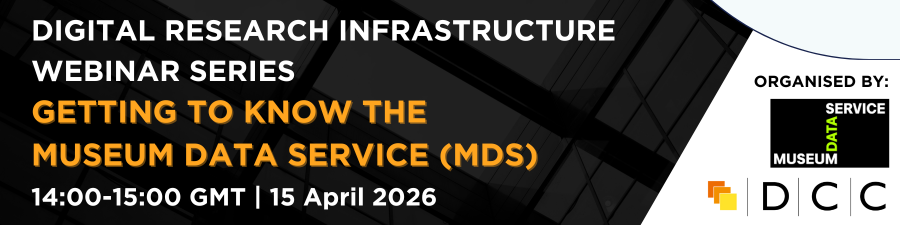
DCC’s Digital Research Infrastructure webinar series
Getting to know the Museum Data Service (MDS)
15:00 – 16:00 CET, 15 April 2026 | Online
The third webinar is now available to register. Taking place in April, this webinar will introduce the Museum Data Service (MDS), a new service that aims to connect and share all the object records across all UK museums. It is a joint initiative by Art UK, Collections Trust and the University of Leicester, supported by the Arts and Humanities Research Council and Bloomberg Philanthropies.
MDS provides access to data drawn from UK collections and gives both a national overview of the collections through summaries, offering object level records as FAIR data to transform the way that researchers access museum collections. Join us to learn more about the services offered by MDS and how they can benefit your research.
Register for the webinar through our Eventbrite page.
Get involved in the DRI Series
If you work on a research infrastructure project or initiative and are interested in being a guest speaker, please email us - info@dcc.ac.uk.
Missed a previous webinar?
Watch the recordings from our first two webinars on YouTube or on our website:
International Journal of Data Curation
International Journal of Digital Curation
Hope for the best, plan for the worst: Reducing risks associated with repository cessation
Opening the 2026 edition of the International Journal of Digital Curation is an article by Jonas Recker, Lisa Pegelow, Alexander Schuster and Reiner Mauer. They examine repository cessation — what happens when a repository must wind down — and set out a clear, risk‑based way to plan for it. The authors apply risk and threat assessment methods, alongside familiar repository assessment practices, to create a practical template developed with repositories in the German Network of Educational Research Data (VerbundFDB).
The template supports both sides of a potential transfer: repositories preparing to cease, and target repositories considering acceptance. By gathering essentials about the collection and the organisational, technical and legal context, the template helps teams spot gaps, prioritise actions, and communicate clearly.
Download the article on the IJDC website.
Resource of the month
New infographic available: the Principles of Open Science Monitoring
A new infographic, designed by the Open Science Monitoring Initiative, presents the Principles of Open Science Monitoring in a clear and accessible format. Developed as a practical guide, the infographic aims to raise awareness of the principles and support their adoption across diverse contexts. It highlights the three key pillars that structure the principles: Relevance and significance; Transparency and reproducibility; and Self-assessment and responsible use.
The infographic can be accessed via Zenodo.
From the community
The Postal Museum Debuts Digital Collections Portal
The Postal Museum launched its Digital Collections Portal in January 2026. This platform provides public access to its born-digital collections for the first time, featuring a user-friendly interface tailored to enhance user experience and accessibility. Helen Dafter, an Archivist at The Postal Museum wrote a blog post on the process of delivering this platform.
Read Helen’s blogpost via the Digital Preservation Coalition website.
For your calendar
What is Agentic AI? Information Session 1
17:30 – 18:30 CET, 16 March 2026 | Online
Agentic AI is transforming the research landscape, but what exactly is it, and how does it differ from the large language models and generative AI tools many of us already use? The Research Data Alliance are delivering a 1-hour webinar with an international panel of speakers providing real-world examples and case studies exploring what makes a tool truly ‘agentic’.
Register for the webinar via the RDA.
Online information session ‘Resilient Digital Ecosystems’
19 March 2026 CET, 13:00 - 14:00 | Online
The Dutch Research Council (NWO) are hosting an online information session on a new call for funding based on developing Resilient Digital Ecosystems. The webinar will provide details about the application process as well as giving participants the opportunity to ask questions.
Learn more about the webinar via the NWO website.
...and finally
It was a pleasure to meet so many attendees old and new at IDCC26 in Zagreb last month. The quality of all the posters and presentations seemed particularly high this year and I often found it difficult to choose which session to attend. I certainly didn’t get to talk with all the poster authors that I wanted to (though I did speak with many of them). One element of our opening keynote from Antica Čulina struck a particular chord with me. Antica is keen to establish mechanisms for pre-registration of research in her field of ecology and suggests that it would be a worthwhile endeavour in other areas of research also. I can only agree. Pre-registration is now commonplace in Clinical Trials. It was an idea that emerged shortly after I began my career in the MRC’s Clinical Research Centre over 45 years ago but took many years to gain widespread acceptance. I hope that progress this time will be more rapid and I will see what the DCC can do to support the concept and its execution.
On a more sombre note we were all saddened at the DCC to learn of the untimely and unexpected death of our colleague John Pinto over the New Year. John had 50% of his time seconded from his primary role in EDINA to work alongside our DMPonline developers for many years, and he was well-known to the wider DMP Roadmap developer community. In that time he had in effect become an honorary DCC staff member and he will be sorely missed personally and professionally. We extend our sympathy to his family and friends.
Kevin Ashley, DCC Director