


You are here
Pipeline Newsletter - May 2026
In this edition of Pipeline, we announce the IDCC27 location, open call for submissions and share a series of interesting events in May and June.
Welcome to the DCC Pipeline newsletter!
Our monthly newsletter features news updates from the community, information about DCC work and services as well as important dates for your calendar. We hope you enjoy!
At a glance...
In this edition of Pipeline, we announce that registration for IDCC26 is now open, introduce our new mascot and highlight some exciting upcoming events.
Not a subscriber? Complete our short webform to receive Pipeline each month.
DCC News

IDCC27 Location announced and Call for Submissions open
The 21st International Digital Curation Conference (IDCC27) will take place in Lisbon, Portugal with a theme of FAIR DO's: Centring People in the Stewardship and Curation of Digital Objects. The theme of this year's conference acknowledges the crucial role of people in the work of making digital objects FAIR.
Call for submissions for the conference are now open. This year we are accepting submissions in five formats; papers, lightning talks, posters, demos (new to IDCC27) and workshops.
Learn more about the submission formats and deadlines on our website.
New report on data curation in physical sciences
Enabling Best Practices in Research Data Curation in Physical Sciences: Recommendations on the Role for PSDI
We have written a new report alongside the Cambridge Crystallographic Data Centre (CCDC) for the Physical Science Data Infrastructure (PSDI) project. The report examines current approaches to research data curation, describes the diverse roles involved across the research data lifecycle and the relevant conceptual frameworks, and provides a set of recommendations to PSDI on how to most effectively enable and advance best practices across the Physical Sciences in the UK.
Case studies are a key part of this work. We include several of them in the report, but would welcome more.
If you have a case study demonstrating the implementation of best practices or the emerging challenges & opportunities in data curation in the Physical Sciences, please get in touch via info@dcc.ac.uk.
Inform the DCC training offering
We are conducting a short survey to understand current and anticipated training needs in research data management (RDM) and Generative AI in research. Your responses will help inform the design and prioritisation of our training offering over the next 12 months.
Complete the short survey by the end of May to help inform the DCC training offering.
International Journal of Data Curation
Preserving Under Pressure: The 2016/2017 Data Rescue Movement and the Limits of Emergency Curation
The first conference paper from our recent IDCC26 event in Croatia has been published. In this article Laura Rothfritz explores the experience of “emergency curation” in reaction to the first Trump presidency in 2016/2017. The paper is based on qualitative interviews with participants in that movement and examines what motivated them, how they acted, and their reflections on the movement. Generalisable lessons emerging from the experience include the importance of trust, political context, and social practice. It concludes that digital preservation in politically volatile time should be grounded in careful action, with accountability, and a view to long-term infrastructural thinking rather than reactive mass-downloads of data sets.
Download the article on the IJDC website.
From the community
Improving the reliability of research management data across the sector
Verena Weigert, who works on the implementation of the Jisc research and innovation sector strategy, wrote an article that discusses the work of the Jisc digital working group. The group brought together research leaders, systems managers, librarians, data professionals and funders to explore how master data management (MDM) can strengthen the coherence, reliability and interoperability of research management data. The discussion highlighted common pressures across institutions and where collective effort could have the greatest impact.
Read Verena’s article on the Jisc website.
For your calendar
DCC/RDA Training now open for bookings
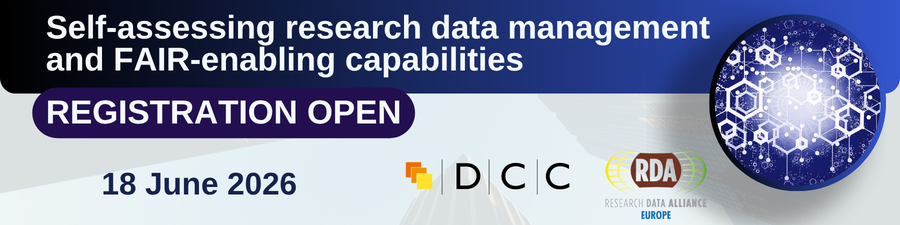
Self-assessing research data management and FAIR-enabling capabilities
09:30 – 12:30 (UTC+1), 18 June 2026 | Online
As effective self-assessments require collaboration and input from several areas of the organisation, this training workshop, co-led by colleagues from DCC and RDA Europe, welcomes professionals who work in a research support role. A discounted registration fee is available for organisations wishing to send two or three participants.
Discover more about the training on our website.
DCC’s Digital Research Infrastructure Webinar Series
Getting to know JASMIN and CEDA
14:00 – 15:00 BST (UTC+1), 10 June 2026 | Online
Join us in May to learn more about JASMIN and the Centre for Environmental Data Analysis (CEDA) from our guest speakers Dr Matt Pritchard and Alison Pamment. JASMIN is the UK's data analysis platform for environmental science. The Centre for Environmental Data Analysis (CEDA) serves the environmental science community providing access to data centres, data analysis & access, and research project participation.
Getting to know Elixir UK
15:00 – 16:00 BST (UTC+1), 17 June 2026 | Online
ELIXIR UK is the United Kingdom’s national Node of ELIXIR, the European infrastructure for bioscience data. They are a distributed research infrastructure and a collaborative network, bringing together leading UK research-performing organisations and the people behind them. We welcome Xènia Pérez Sitj, the Deputy Coordinator and Stakeholder Engagement Lead at ELIXIR UK as our guest speaker.
Get involved in the DRI Series
If you work on a research infrastructure project or initiative and are interested in being a guest speaker, please email us - info@dcc.ac.uk.
RDA Plenary 27
6th – 8th October 2026 | The Oval, London
The 27th RDA plenary is coming to London this year with the theme of “Shaping the Global Research Commons.” Registration fees have now been announced and registration itself will open shortly. There’s still time to submit a poster or to submit a new proposal type – a 7- minute idea pitch. You can also take the opportunity to run a co-located event on the day before or after the plenary itself. Sponsorship opportunities are available. Find more details about all of these on the plenary web pages.
Research Integrity: Best Practices for High-Quality Metadata for Publishers
14:00 –15:00 BST (UTC+1), 19 May 2026 | Online
ORCID are hosting a webinar series throughout May, inviting thought leaders and experts in research and cyber security to share their insights about trends and emerging solutions. This webinar will present how publishers have moved from reactive data correction to proactive system integration.
Learn more via ORCID’s Zoom registration page.
From Project to Platform: New Resources on PSDI
14:00 –15:00 BST (UTC+1), 21 May 2026 | Online
In May, the Physical Sciences Data Infrastructure (PSDI) launched a series entitled “From Project to Platform: New Resources on PSDI”. The series aims to showcase high-quality tools and resources and introduce them to a broader community. The third webinar in the series will present two case studies that showcase how PSDI resources support data analysis.
Find out more and register via the PSDI website.
DMPonline Community Event
10:00 – 13:00 BST (UTC+1), 26 May 2026 | Online
Announced in last month's pipeline, we’d like to let our new readers as well as our current subscribers know that the DMPonline Community event registration is still open. Whilst this webinar presents collective work from the DMPonline team and current customers, all those interested in creating, managing and working with data management plans, including researchers, data stewards, research support staff, librarians, and also research data platform managers are welcome to attend.
Learn more on our website.
...and finally
Nominations for The Sarah Jones award will be closing in less than a month, on 14th June 2026. Established by RDA and supported by GÉANT, DCC and others, the award is for individuals whose work has had a significant positive impact on collaborative Open Science practices. This impact can be on an organisational, community or individual level. Nominations for Early Career candidates are strongly encouraged, as are nominations from regions less well-represented in the Open Science field. The winner will receive a physical award, a certificate, and will have access to a fund to be invested in activities relevant to the winning activities. Find more information about the submission process and criteria on the award web page.
As you are a Pipeline subscriber I am sure that you either know of someone deserving of the award or are eligible yourself. As a member of the award selection panel I urge you to act before the submission deadline next month. The winner will be announced at the RDA plenary 27 in London in October.
Kevin Ashley, DCC Director